Why does logging vendor sales at a farmers market matter for grant applications?
Grant reviewers want evidence that a market moves real money to local producers. A simple, consistent sales log turns a vague claim into a number you can defend.
What grant reviewers actually ask for
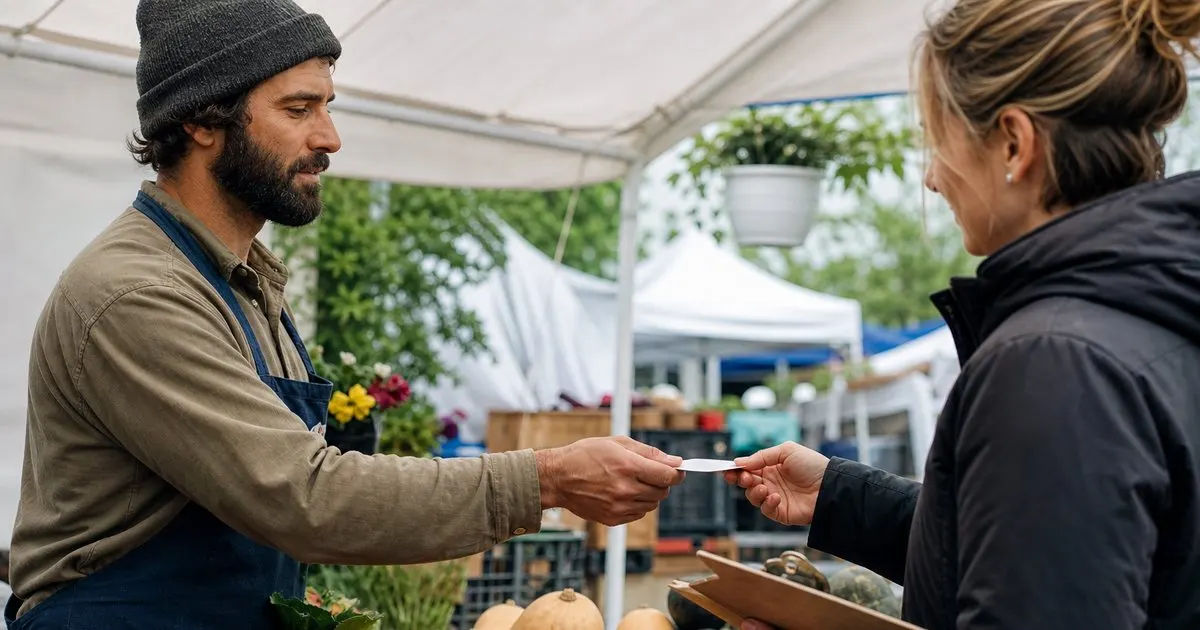
Most funding sources for markets, whether a federal program such as the USDA's farmers market promotion grants, a state agriculture department, a community foundation, or a local hospital's community benefit fund, ask a version of the same question: what happens to the money that shoppers spend here? They want to know how many producers sell at the market, roughly how much they sell, whether that number is growing, and whether low-income shoppers are part of the picture. A market that can answer with figures pulled from its own records reads very differently from one that says "we believe our vendors do well." Related: Keeping Vendors Happy
The catch is that the questions arrive when the application is due, not when the season is running. If you did not log sales during the season, you are left estimating from memory or asking vendors to reconstruct a year after the fact, which produces numbers nobody trusts, including you. The market that logs weekly, even roughly, can build a baseline in its first season and show a trend by its second, and a trend is what turns a one-time award into repeat funding. Related: Planning a Market Season
Keep reading: Running a Farmers Market Without the Clipboard, Fair Stall Allocation, Keeping Vendors Happy. See how StallBookr helps you stall booking and sales logging for farmers markets.
What to log without burdening vendors
Vendors are busy at close and they are rightly wary of sharing exact income. A workable compromise is a self-reported gross sales figure for the day, entered by the vendor or by a volunteer at checkout, rounded to a range if that is what it takes to get participation. Some markets pair this with a customer count at the entrance, taken with a clicker for a fixed window every hour, and a count of SNAP or incentive tokens redeemed. Those three numbers, collected consistently, cover most of what an application will ask.
Consistency matters more than precision. A rough figure collected every market day is far more useful than an exact figure collected three times a season. Tell vendors why you are asking, promise that individual figures stay private and only totals or averages leave the office, and honor that promise in every report. Markets that do this typically see participation climb once vendors realize the aggregate numbers help fund the tents, the signage, and the incentive programs they benefit from.
Turning a log into a grant narrative
Raw totals are a starting point, not a story. Reviewers respond to numbers that are framed against something: sales per vendor per market day, sales in the weeks a new incentive program ran compared with the weeks before, or the share of total sales that went to farms within a stated distance. Each of those comparisons requires that your log carry a date, a vendor identifier, and a category, which is why it is worth deciding on those fields before the first market day rather than adding them later. Related: Fair Stall Allocation
Keep the narrative honest. If sales were flat or a rainy stretch dragged a month down, say so and explain what you learned. Reviewers read a lot of applications that claim everything went up, and a candid account with real figures tends to be more credible. Note the limitations of self-reported data in a sentence, then move on. Funders understand that a volunteer-run market is not running an audit.
Keeping the data usable year after year
The most common failure is not a lack of data but data scattered across a notebook, two spreadsheets, and a former manager's email. Store the log in one place that outlives whoever is running the market this year, with a column layout that does not change mid-season. If you use software built for markets, such as StallBookr, the vendor, stall, date, and reported sales are tied together automatically, but a well-kept spreadsheet with the same fields works too. Related: Running a Farmers Market Without the Clipboard
Before each grant cycle, export a season summary and file it with the application so that next year's applicant can see what was claimed and where the figures came from. Boards change, managers change, and the reporting requirements on a grant you win will land a year or two later, often asking for the same metrics again. A market that can reproduce its numbers on demand keeps its funders, and funders talk to each other.
- Grant reviewers want counts and trends drawn from your own records, not estimates made at application time.
- Three consistently collected numbers, vendor gross sales, shopper counts, and tokens redeemed, cover most applications.
- Frame totals as comparisons, such as sales per vendor per day, and be candid about flat periods.
- Keep the log in one durable place with fixed fields so future managers can reproduce every figure.

Julien Jimenez
Julien Jimenez is an independent software builder based in Paris. He designs, ships, and operates focused SaaS products for small businesses and independent professionals. Read the full author page.
Run your market without the clipboard
Stall booking and sales logging for farmers markets. StallBookr is built to help you put this into practice.
Open bookingsMore from the StallBookr blog
Running a Farmers Market Without the Clipboard
Fair Stall Allocation
Keeping Vendors Happy
Get the StallBookr playbook
Practical guides on market management, straight to your inbox as we publish them. No spam, unsubscribe any time.