What is the best way to lay out a farmers market so shoppers reach every stall?
Stalls at the far end of a market earn less for reasons that have nothing to do with the vendor. Layout decisions fix that, and they are cheaper than adding vendors.
Why the far end of a market goes quiet
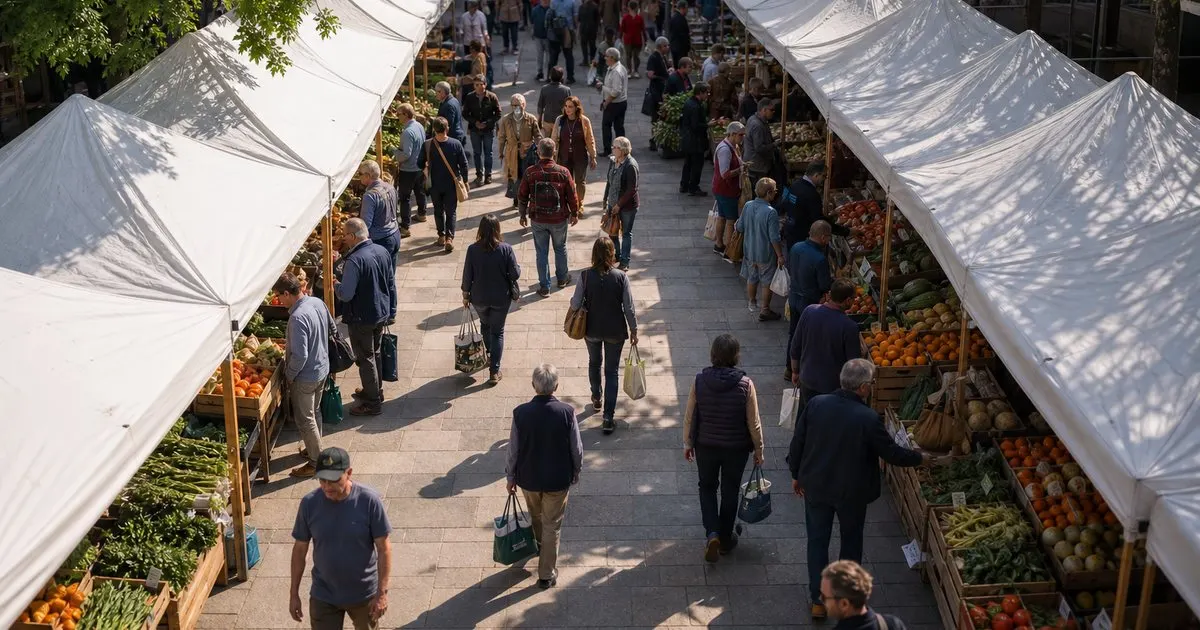
Shoppers arrive at a market with a rough plan: get the things they came for, look at anything interesting on the way, and leave when the bags get heavy. In a single long row, most of that shopping happens in the first two thirds. By the time someone reaches the end, they have spent their budget and their arms are full, and the last few vendors get browsed rather than bought from. Those vendors notice, and they blame the market when their sales lag behind stalls near the entrance. Related: Keeping Vendors Happy
The quiet end is a layout problem, not a vendor problem, and it shows up in sales logs as a consistent gap between stall positions rather than between vendors. If you rotate a strong vendor into a weak position and their numbers fall, you have confirmed it. Fixing it means giving shoppers a reason to keep walking and a route that brings them back past stalls they skipped.
Keep reading: Running a Farmers Market Without the Clipboard, Fair Stall Allocation, Keeping Vendors Happy. See how StallBookr helps you stall booking and sales logging for farmers markets.
Shapes that keep people moving
The horseshoe or loop is the most forgiving layout for a small to mid-sized market because it has no dead end. Shoppers walk one side, turn the corner, and walk back along the other, passing every stall once without doubling back. Where a loop is not possible, a double row with vendors facing each other across a wide aisle works well, provided the aisle is wide enough for two strollers to pass and a wheelchair to turn, which in practice means wider than you think. Related: Running a Farmers Market Without the Clipboard
Avoid single rows that end at a wall, a parking lot, or a blank fence. If the site forces a linear layout, put something worth reaching at the end: a prepared food vendor with seating, live music, or the coffee stand, so the end becomes a destination and shoppers pass the stalls on the way there and again on the way back.
Placing anchors and mixing categories
Anchor vendors are the ones people come for: the big produce grower, the bread baker, the egg farm that sells out by ten. Spread them out rather than clustering them near the entrance. An anchor at each corner of a loop pulls shoppers around the whole circuit, and the smaller vendors between anchors pick up the browsing that happens along the way. Coffee and breakfast items belong near the entrance because shoppers buy them first and carry them while they browse.
Mix categories so that no stretch of the market is all soap or all jam. Two produce stalls side by side compete on price in front of the customer; two produce stalls separated by a flower vendor and a cheesemaker each get a fair look. Prepared food that generates lines or smoke should sit where the line does not block a neighbor's table, ideally at a corner or on the outside of the loop with its own space to queue. Related: Fair Stall Allocation
Managing the map through the season
A fixed layout has real advantages: regulars know where to find their vendors, and vendors can build a rapport with their neighbors. But fixed does not mean permanent. Review the sales log by stall position at midseason and again at season end. If a position underperforms across different vendors, change the position, not the vendor. Rotate weaker positions to newer vendors who have not yet built a following, and reserve the strongest for the anchors who bring traffic.
Keep the map in a form you can update quickly and share the same day. When a vendor cancels on market morning, an empty stall in the middle of a row breaks the flow of the aisle, so have a plan to shift neighbors inward or move a waitlisted vendor into the gap. Stall booking tools that pair a map with the booking list make this a two-minute job; a laminated map and a marker are a fine fallback as long as everyone at check-in is looking at the same version. Related: Tracking Stall Fees Cleanly
- Stalls at a dead end sell less regardless of who occupies them, and sales logs by position will show it.
- A loop or horseshoe with a wide central aisle passes shoppers by every stall without doubling back.
- Spread anchor vendors across the circuit and separate direct competitors with other categories.
- Review sales by stall position twice a season and fix weak positions rather than blaming vendors.

Julien Jimenez
Julien Jimenez is an independent software builder based in Paris. He designs, ships, and operates focused SaaS products for small businesses and independent professionals. Read the full author page.
Run your market without the clipboard
Stall booking and sales logging for farmers markets. StallBookr is built to help you put this into practice.
Open bookingsMore from the StallBookr blog
Running a Farmers Market Without the Clipboard
Fair Stall Allocation
Keeping Vendors Happy
Get the StallBookr playbook
Practical guides on market management, straight to your inbox as we publish them. No spam, unsubscribe any time.